Around the World in 80 Days

Creator: Jules Verne (novel), David N. Titcher (screenplay), Staring Jackie Chan, Steve Coogan, and Jim Broadbent

Media Type: Feature Film, 120 minutes

Audience: Family Friendly


Summary:

Phileas Fogg is a brilliant inventor living in Victorian London. His inventions fill his home with whistle-activated light bulbs, an automated fan system, and a steam-hydraulic vehicle for when he doesn’t want to wear his wheeled shoes around. After he discovers that man can travel at 50mph via experiments with steam-powered rockets, he goes to announce his discoveries to the Royal Academy of Science. The Royal members, though, are unimpressed. Desperate to earn the respect of his fellow scientists Fogg makes an incredible wager: if he can make it around the world in 80 days he replace Lord Kelvin and become the new head of the Academy. However, if he loses, he must publically denounce his inventions, destroy his laboratory, and never enter the Academy again. With the assistance of his newly acquired French-Chinese valet, Passepartout, Fogg sets out to complete his quest. The journey already promises to be difficult from the word go, but the sabotages set upon them by Lord Kelvin, as well as a mysterious assembly of Chinese assassins focused on Passepartout, this wager could cost Fogg more than he bargained for.


Bottom Line: Filled with steam powered inventions, colorful cravats, and a hilarious collection of unexpected guest appearances this movie is an all around delightful.


Read More:

http://www.imdb.com/title/tt0327437/?ref_=nv_sr_1

Evan Butterfield Photography

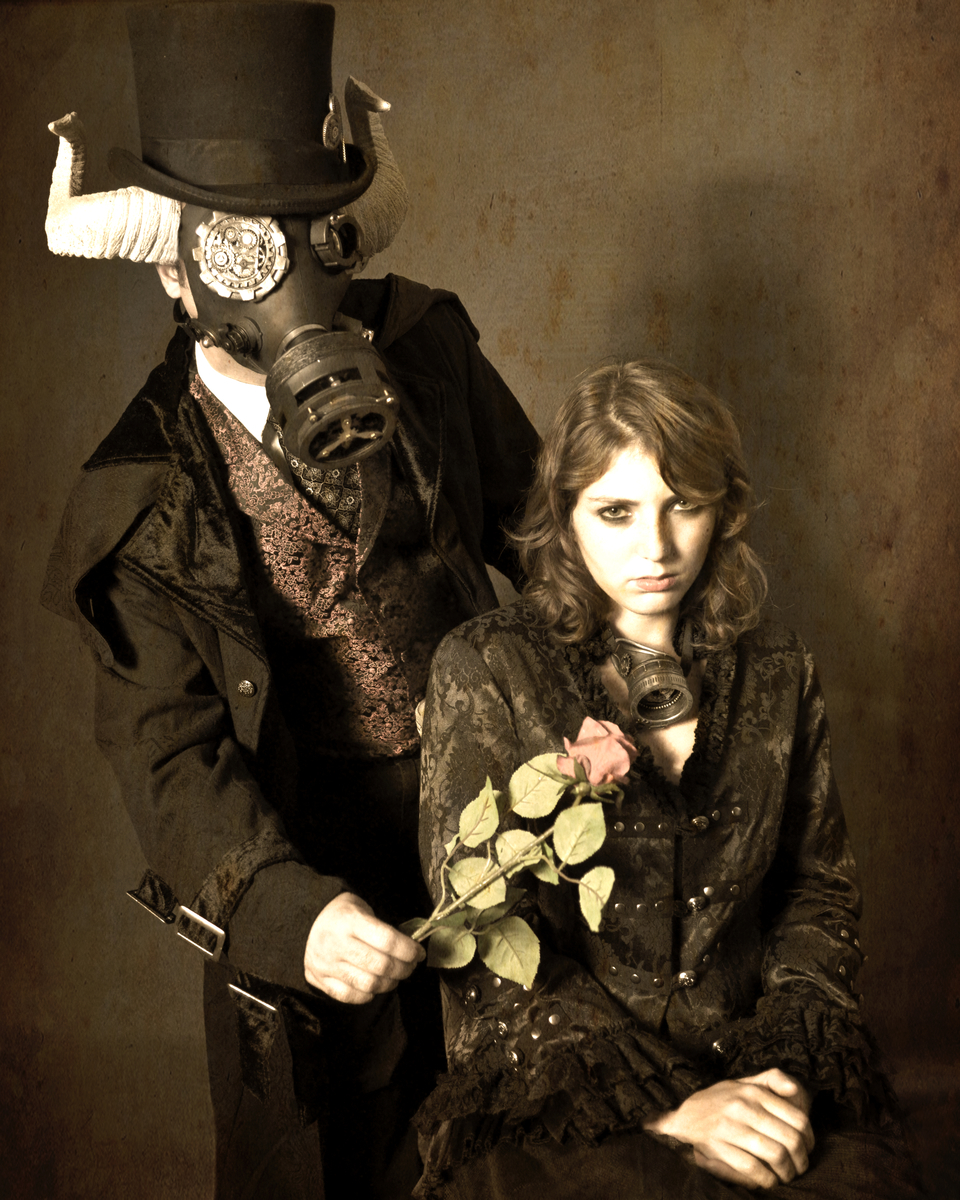
Evan Butterfield is a photographer based out of California. His work covers a wide array of topics, but lately he’s found he has an exceptional eye for steampunk.

"Your Hair Wants Cutting" c2014
“Your Hair Wants Cutting” c2014

Starting with custom created costumes and accessories with models enthusiastic about dress-up, Mr. Butterfield’s finished pieces encompass the best of traditional and digital photography. The images begin as detail-oriented traditional photographs that are then digitally manipulated to create a unique, antiqued look. Many images are faded, other crinkled, and some so meticulously edited that they look like they were lost in a drawer for generations.

Originally trained in English and a holding a degree in Law, Mr. Butterfields’s inspiration comes from his passion for literature and the steampunk butterfly affect: the notion that things are so dramatically altered by one small technological change. He credits The Difference Engine and The Diamond Age as his gateway and various conventions as his visual inspiration. In all of his steampunk works, he represents what he calls the “triple goddesses” of this particular SciFi aesthetic: Curiosity, Progress, and Science.

“It all comes down to the stories being told,” he said during our lovely phone conversation, “re-imagined into photo reality”. This reimaging comes in a variety of formats, from his series of literary themed pictures to turning Victorian sexism on its head through a series of “Steampunk Beefcake” shoots.

Steampunk Vincent  c2014
Steampunk Vincent c2014

Even though his art is labeled SciFi, Evan Butterfield has a much more down to Earth feeling about the genre. “Despite all the gears steampunk is not divorced from reality,” he says, “its just playing with themes that have always been there – using them to connect.” This enthusiasm and social understanding of the esthetic come through with every image, and I personally cannot wait to see what he comes up with next.


Beauty and the Beast c2014

Evan’s work is available for license or purchase via his online gallery,  or at FineArt America.

Read more about his process and stay up to date on projects by following his blog, Lens Caps.

Jeremiah Congleve, Reflecting  An informal portrait of young Master Jeremiah Congleve, Tertiary Journeyman at the Royal Aetheric Engineering Academy. In later life, Congreve’s work with filamental liquid phenomena would revolutionize phlebotic medicine, military strategy, and commercial air transport; but during his student and journeyman years he struggled with personal demons (of the psychological, rather than phantasmal variety), inappropriate social behaviours, and, as has been previously suggested, rare varieties of addiction. That he overcame these obstacles to become one of the first non-nobles to ascend to the Board of the Imperial College speaks volumes both for his manly character and, of course, for the class-blind and deeply democratic principles that have always been at the very core of the Royal Scientific order, if not always visible on its surface.
Jeremiah Congleve, Reflecting
An informal portrait of young Master Jeremiah Congleve, Tertiary Journeyman at the Royal Aetheric Engineering Academy. In later life, Congreve’s work with filamental liquid phenomena would revolutionize phlebotic medicine, military strategy, and commercial air transport; but during his student and journeyman years he struggled with personal demons (of the psychological, rather than phantasmal variety), inappropriate social behaviours, and, as has been previously suggested, rare varieties of addiction. That he overcame these obstacles to become one of the first non-nobles to ascend to the Board of the Imperial College speaks volumes both for his manly character and, of course, for the class-blind and deeply democratic principles that have always been at the very core of the Royal Scientific order, if not always visible on its surface.


Truth is Stranger Than Fiction

Program Type: Workshop, possible series

Audience: Teens and Adults, groups up to 10 persons

Time Frame: One hour per session

Space Needed:

  • Tables and chairs
  • Computer and projector
  • Ideal: Tour of collections

Budget Considerations:

  • Staff time
  • Honorarium for guest speakers

Description:

The Federal Depository Library Program is a plan by the Federal Government designed to provide free, guided access to a variety of government publications. These include Hearings, Supreme Court decisions, and less spot-light publications like geographic studies, and Patent Office collections. For full details see the Government Printing Office site: http://www.gpo.gov/libraries/public/


These collections offer incredible insight into US history, and it’s true, sometimes the truth is stranger than fiction. Working in collaboration with your local government documents librarian, create a series of workshops highlighting the pieces of the collection that would be of value to steampunk writers, costumers, or just your general Victorian history buff. Topics to consider are:

  • The U.S. Patent & Trademark Office- crazy brilliant inventions from the Wild West to the elite leisure creations of Edwardian 5th Avenue. Research the technologies people hoped to create as a way to build your own steampunk worlds.
  • Bureau of Indian Affairs collections – understand the realities of Natives in Victorian America and see the language authentic to the period.
  • Maps – Many Regional Depositories collect maps and other geographic publications. These show how regions of the US changed over time and how those changes affected the people living in those areas. Original copies may also include fold-out illustrations that were hand-created, a respectable form of employment for women of the day.
  • Health, Education, Labor & Pension Committee- Started in 1869 as the Committee on Education and in 1884 through the mid-1900s it was known as the Education and Labor Committee these papers give insight into the mental and health state of the US. These realities add authenticity to any steampunk story.
  • US Code and State Statues- What laws were in affect in 1880 that aren’t now? What states had public decency laws regarding swimsuits? What about immigration in 1897? Searching through old copies of federal and state legal volumes can add the details needed to make every costume realistic and every story true to period.


Online Resources-

Find your local Depository: http://catalog.gpo.gov/fdlpdir/FDLPdir.jsp

FDLP Training: http://www.fdlp.gov/about-the-fdlp/training-and-events

American Library Association Government Documents Round Table: http://www.ala.org/godort/front

NaNoWriMo Emergency Novel Finishing Kits

Program Type: Writing Kits

Audience: Adults, Teens

Time Frame: November

Space Needed: Display space for canisters

Budget Considerations:

  • Canisters
  • Instant Coffee Packets
  • Granola Bars
  • Pencils
  • Stationary
  • Staff Time

Description:

National Novel Writing Month – every November writers of all levels take the challenge to write a full novel (or at least a good chunk of one) in the month of November. The challenge is supported through social media campaigns, writing groups, and web tracking via nanowrimo.org. The site also hosts postings related to writing help and organizes local events. As librarians, we can encourage writers to use the library as their writing space, research space, or just a place to come and get support as they take on hundreds of words a day. This project is designed to show that support while also spreading the word to those who may not have heard of NaNoWriMo. Images of canisters filled with tools to help writers have been floating around Tumblr and Pinterest, and the idea can be easily modified to help support Steampunk writers in November.

For each canister (likely a poster-tube, or for the thrifty a modified/sealed paper towel roll), instead of creating a generic kit, make them decorated and filled with cards with genre-specific sentence starters and other helpful pieces of inspiration. In addition to the coffee, pencils, and stack genre canisters might be filled with:


Steampunk: small pictures of Steampunk machines, note cards with quotes like “Steampunk creations may be mechanical, sculptural, or purely decorative… Whatever the application, the art celebrates a time when new technology was produced, not by large corporations, but by talented and independent artisans and inventors” from Art Donovan’s The Art of Steampunk (2011), tiny paper mustaches, top hats, and a small list of in house resources. The outside of the canister can be decorated with more paper top hats and closed with corset-lace styled ribbons.


Fantasy: A canister covered with a glittery paper dragon is attention grabbing no mater it’s location in the library. Filled with a wand, a list of online creature name generators, and quotes from J. K. Rowling, Tolkien, and Goodkind the magic is sure to start flowing.


Romance: A deep red canister filled with chocolates; who wouldn’t fall in love with a little chocolaty inspiration? Cards filled with synonyms for “love” (predilection, delight, adoration), pictures of the sunset, and a list ‘legitimate’ authors who also write romance (like Sabrina Jeffries who earned her PhD on James Joyce but makes her living writing romance) are sure to get blood pumping.


Children: NaNoWriMo isn’t just for grown-ups! This idea can also be easily modified for children, particularly during a day camp. Give each child a canister filled with a sentence starter (“Then suddenly the door opened”, etc), a few pictures, and a character name. Give them time to write a story using all the pieces from their canister and have them share with the group.


Online Resources:

http://nanowrimo.org/

http://gamenaminator.com/creature.php

Victorian Movie Monsters

Program Type: Film Series/Book Group

Audience: 13+

Time Frame: Varies

Space Needed: Film viewing room, book group meeting room

Budget Considerations:

  • Film showing rights, if applicable
  • Custodial for rooms
  • Popcorn/snacks for movie nights

Description:

When you think of monsters who comes to mind? Frankenstein? Dracula? The Victorian monsters became the staple of the silver screen for a reason: their stories are equal parts terror and intrigue. Since there are so many film options now the monsters make themselves an easy pick for a mini-film festival.

The festival can be stand-alone, or tied in to other programs, like a book group. The original story behind the films are very short (Dr. Jekyll and Mr Hyde, The Invisible Man, The Portrait of Dorian Grey) which are well suited for teen readers. For adults Frankenstein, Dracula, or a Jack the Ripper novel lend themselves to longer book group discussions. The film showings are a great way to stir up interest and advertise the book groups to an audience with a noted interest.

Book Spine Poetry

Program Type: Book Display

Audience: Varies

Time Frame: Passive

Space Needed: horizontal book display space – or image display space

Budget Considerations: none (unless printing images of the poems for display)

Description:
Spine poetry is a display that has been floating around Flickr, Pinterest, and Tumblr. It’s very simple: you take the titles of books, as displayed by their spines, and create poems by stacking books so their titles create a small poem, joke, or story. For example three books titled Through the Looking Glass, Bad Cat, and Go Ask Alice become a short story by stacking them to read Bad Cat/ Through the Looking Glass?:/ Go Ask Alice. While this isn’t a steampunk only display it is a way to show the creativity of steampunk titles and the visual aspect of their covers by incorporating them into these spine-poems. It also shows the genre to people who may not normally look at them. These displays can be of the physical books, stacked on top of the shelves, or photographs of the book stack can be displayed on the walls. This would be a fun project for School Librarians who have TAs, or public libraries that have young volunteers. It allows creativity and is a great way to get familiar with your collection.

Example:

  • Infernal Devices by K.W. Jeter
  • What Could Go Wrong? by Willo Davis Roberts
  • War of the Worlds by H. G. Wells

F/NF Crossover Displays

Program Type: Display

Audience: Teens

Time Frame: Passive

Space Needed: Display board or wall space

Budget Considerations:

  • Paper materials for display
  • Staff time for creation
  • Staff time for book lists/book pulling

Description:

This is a display aimed at bridging the gap between fiction and non-fiction. Many Steampunk books are based on a historical reality, and then they alter and bend that reality to fit the author’s intentions. For many readers (myself included) part of the joy of steampunk is seeing the changes made and what stays true to history. For many teens, though, there may not be as much background understanding of the historical reality to fully appreciate the nuanced changes: this board is aimed at bridging that gap. Additionally, this board can be important for librarians working in communities with Common Core English classes where there is a high expectation for nonfiction reading by teens. By showing the connection between fiction and nonfiction librarians can tap into an expressed interest (steampunk or speculative fiction) and present nonfiction content in that same interest. Depending on the books pulled this can also be used for WWI and Civil War specific books.

Online Resources:

  • Leviathan by Scott Westerfeld paired with The Assassination of the Archduke: Sarajevo 1914 and the Romance that Changed the World by Greg King, Sue Woolmans
  • Boneshaker by Cherie Priest paired with Seattle Underground by William Speidel
  • Wild, Wild West (film) with A Lady’s Experiences in the Wild West in 1883 by Rose Render

Victorian Tea Time

Program Type: Family/Snack Time

Audience: Family, 10+ participants

Time Frame: 1 hour

Space Needed: Open space with tables and chairs

Budget Considerations:

  • Snacks
  • Tea
  • Plates and cups
  • Clean up

Description:

Tea time is a simple idea with lots of ways to modify it to fit your library.

  • Do you offer snack time for school kids? Add a little Victorian flair by talking about etiquette and letting the kids play make-believe. Read a steampunk short story during the snack.
  • Do you have a book club that meets regularly? Host a public meeting (preferably the first meet up) with tea, top hats, and your first discussion of your group’s Steampunk book selection.
  • Is there a convention coming to your town? Offer a pre-convention meet up for the locals to have tea, show off their costumes, and get excited for the event. Use the meet up as a chance to highlight your collection’s books on costume construction, crafting, and DIY jewelry.

Adventure Book Board

Program Type: Display

Audience: All

Time Frame: Passive

Space Needed: Display board or wall space

Budget Considerations:

  • Paper, lettering, and adhesive for display
  • Staff time to create images
  • Staff time to create book lists/Pull books

Description:

Modified from the “Where Would Poe Go?” board at the Enoch Pratt free library (view the image via Fliker here https://www.flickr.com/photos/enochprattlibrary/6195747384/).

This board would highlight nonfiction Victorian and Steampunk adventure books in your collection. Using images of classic landmarks (Big Ben, Eiffle Tower, Pyramids) paired with a question like “Where Will Adventure Take You” or “Where Will You Go?” or using a classic Victorian figure like “Where Would Verne/Tesla/Poe Go?”. This is a chance to draw attention to the visual side of steampunk literature by include the image of a large mechanical dirigible, balloon, or flying machine passing over the landmarks. Depending on your space you can have physical copies of the books underneath the colorful board, or have printed copies of the book covers attached to it.

Online Resources:

  • A Lady’s Experience in the Wild West in 1883 by Rose Pender
  • Fine Young Turks (Galvanic Century #7) by Michael Coorlim
  • 20,000 Leagues Under the Sea by Jules Verne (book and film editions)
  • Blameless by Gail Carriger
  • Airborn by Kenneth Oppel
  • The Volcano Lady: Vol. 1 – A Fearful Storm Gathering by T. E. MacArthur
  • Shanghai Steam edited by Renee Bennett

Steampunk Claytraptions, a project developed by Heidi Boyd

Program Type: Art/Crafting

Audience: Teens and Adults, approx 10-15 per session

Time Frame: One hour minimum, two better

Space Needed: Table space for materials and participants

Budget Considerations:

  • Space – does your library have a space with enough tables and chairs?
  • Clay- will you ask people to bring their own or provide clay?
  • Mechanical Pieces – these can be hinges and screws from a hardware store, gears and wire from old clocks, but your best bet would be jewelry and scrapbook pieces from JoAnn’s, Oriental Trading Company, or local craft stores. A small fee could also be charged to cover costs.
  • Instructor – Do you feel confident leading the time?

Other options for instructors include recruiting a teen leader who may need volunteer service hours and education/library students who need credit for volunteer service or better yet who may need experience planning and running hands on workshops.


Description:

This program is all about creativity! Using craft clay and mechanical odds and ends participants create their own original pieces of art. From clay birds with hinge wings to watches turned into Steampunk bracelets, a mixture of red, orange, gold, and brown clay with gears, wire, screws, and brass tacks make for truly steampunk inspired designs. By providing a variety of components users can build based on their own comfort level. Completed projects could include:

  • Original clay pieces with incorporated mechanical pieces
  • Watches/Necklaces/Bracelets modified with clay and gears
  • Picture frames with clay and wire steampunk motif edging
  • Fridge magnets refaced with clay and decorated with spiral wire.

This program is safe for teens and adults, and possibly for children with 1-to-1 adult supervision, since the choking hazard of the small parts is a serious consideration. The project requires no previous knowledge and allows users to walk away with a completed piece of art. I would suggest hosting this project before holidays like Mother’s Day/ Father’s Day/ Grandparent’s Day to allow users to create custom gifts at low to no cost.


Online Resources:

Find example pictures from the original blog posting by Heidi Boyd here – http://heidiboyd.blogspot.ca/2011/05/steampunk-claytraptions.html